
- Website:https://www.gosad.org.uk
- Phone Number:020 8571 9529
- Email Address:admin@gosad.org.uk
- Contact NameYousra Razak
Ongoing Project
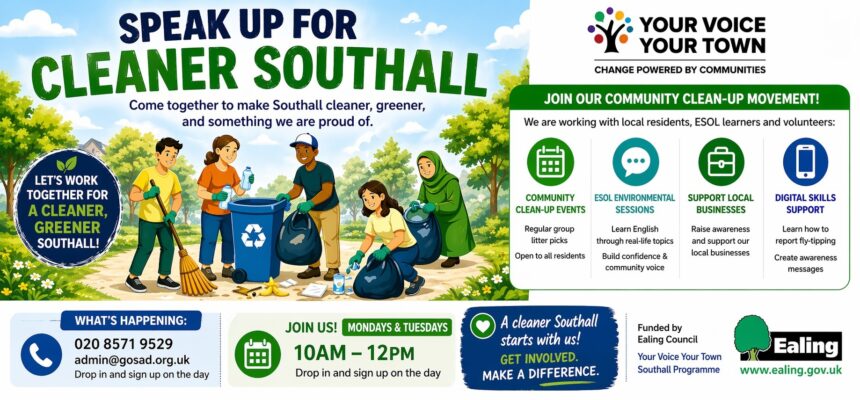
ESOL Environmental Ambassadors Project
Golden Opportunity Skills and Development (GOSAD) is a Southall-based registered charity established in 2003. We support local residents through ESOL, digital skills, advice and community programmes, particularly working with migrant communities, older residents and people experiencing social or economic disadvantage.
Through the Your Voice Your Town Southall Community Fund, we delivered Speak Up for a Cleaner Southall ESOL Environmental Ambassadors Project from April to September 2026.
The project was developed in response to concerns from our learners and local residents about litter, fly-tipping and rubbish around Featherstone Terrace and surrounding areas of Southall. Our aim was not simply to organise clean-ups, but to give local people the knowledge, confidence and practical skills to play an active role in improving their neighbourhood.
Our ESOL learners became Environmental Ambassadors, combining English-language learning with environmental awareness, digital skills and practical community action. The project involved GOSAD staff, volunteers, ESOL and digital learners, local residents and local businesses.
We delivered a six-month programme combining environmental learning, digital skills, community clean-ups and engagement with local businesses.
We held four community clean-up events, with a total of approximately 60 people participating. GOSAD staff and volunteers supported our ESOL learners and other local residents to clean streets, green spaces and areas affected by litter and dumped waste around Southall.
The photographs provide strong evidence of the practical work undertaken. They show learners and residents working together in high-visibility vests, using litter pickers and refuse bags to clear litter from streets, pathways and green spaces. They also show substantial quantities of rubbish collected, including one clean-up where numerous full refuse bags were gathered for disposal.
Environmental topics were incorporated into our ESOL sessions. Learners developed English vocabulary and understanding around litter, recycling, different types of waste, fly-tipping and looking after their local environment.
We also delivered digital/reporting sessions, teaching participants how to identify and report fly-tipping and other environmental problems and how to access relevant information and services online.
Another important part of the project was engaging local businesses. Our learners and volunteers visited 15 local businesses, sharing environmental awareness messages and encouraging businesses to play their part in keeping the surrounding area clean.
Overall, we delivered the main elements proposed in our original application: education, digital awareness, business engagement and visible community action.
The project made a difference both to the physical environment and to the people who participated. The most immediate difference was visible. Our four clean-up events removed significant amounts of litter and rubbish from local streets, pathways and green spaces. The photographs show participants tackling everything from small pieces of litter to areas where larger quantities of rubbish had accumulated.
However, one of the most important outcomes was the change in participants’ knowledge and confidence.
Learners told us that they had learned how to report fly-tipping, something many had not previously known how to do. They also developed a better understanding of different types of rubbish, what can and cannot be recycled, how items should be disposed of and where different materials can be recycled.
This was particularly valuable because the original project identified language barriers and limited awareness of council reporting systems as factors preventing some residents from taking action on environmental problems.
Participants were able to put their learning into practice rather than only discussing environmental issues in a classroom. This helped develop English-language and digital skills in a practical context while also increasing confidence to take action in their neighbourhood.
The project also helped create a stronger sense of community ownership and pride in Southall. Around 60 people participated in the clean-ups, demonstrating that local residents are willing to give their time and energy when they are provided with an accessible way to become involved.
Engaging 15 local businesses extended the project’s message beyond our learners. It opened conversations about the shared responsibility of residents, businesses and community organisations for keeping Southall clean.
The feedback from learners was very positive. Participants particularly valued learning practical information they could continue to use after the project, rather than environmental awareness being limited to the duration of the funded activities.
One of our biggest lessons was that practical action is a very effective way of engaging people in environmental issues.
Environmental messages can sometimes feel distant from people’s everyday lives. Litter outside someone’s home, rubbish in a local park or fly-tipping on a street they use every day is different. People immediately understand the problem and can see the result when they take action.
We also learned that combining environmental awareness with ESOL and digital learning works extremely well. Rather than treating these as separate subjects, learners practised English while discussing real environmental problems and developed digital skills by learning how to report those problems.
Something particularly positive was the willingness of learners to participate directly in the clean-ups. The photographs show participants actively picking litter, carrying rubbish bags and working together across different parts of the neighbourhood. This demonstrated that learners did not just want information they wanted the opportunity to contribute.
We also learned that business engagement can take time. We originally hoped to reach around 30 businesses and ultimately engaged 15. This taught us that face-to-face business engagement needs sufficient time and repeated contact, particularly where businesses are busy or the person responsible is not available when volunteers visit.
Our main learning is therefore to keep community action practical, local and accessible. Start with an issue residents recognise, give them the knowledge and tools to do something about it, and create opportunities for them to act together.
Although the funded project has ended, we do not want the learning or community involvement to end with it.
We will continue incorporating environmental awareness into our ESOL and digital inclusion programmes, including recycling, responsible waste disposal, reducing waste and using online services to report environmental problems.
We will encourage learners who participated in the project to continue acting as Environmental Ambassadors by sharing what they have learned with their families, friends and neighbours.
Where resources allow, we also want to organise further community clean-ups and continue engaging local businesses and residents. The equipment purchased through the project, including litter pickers, high visibility vests, gloves and other clean-up materials, can support future activities and therefore provides a legacy beyond the original six-month project.
We would particularly like to build on the relationship between learning and community action. The project showed us that people can develop English, digital skills, confidence and environmental awareness at the same time as making a visible contribution to their neighbourhood.
We would say: start with something local that people genuinely care about and listen to the people who live there.
You don’t necessarily need a large or complicated project to make a difference. Our project started with a very straightforward concern residents and learners wanted a cleaner Southall. From that issue we were able to bring people together, improve environmental knowledge, develop English and digital skills, engage local businesses and take visible action in the community.
Give local people an active role rather than simply telling them what needs to change. When people can see the results of their own contribution, it creates confidence, ownership and pride.
Our experience of Your Voice Your Town has shown that small, practical actions can bring communities together and create the foundations for longer-term change.
The strongest message from our project is simple:
Listen to local people, give them the knowledge and tools to act, and then support them to make the change they want to see in their own community.
Speak-Up-for-a-Cleaner-Southall-Flyer.pdf
The Resource Centre, Featherstone Terrace, Southall UB2 5AL, UK

